To “zzzz…” and anybody else who has recently subscribed to my blog on WordPress, pleae go to abigailpadgett.substack.com and subscribe there. I’m just keeping WordPress as a basic website but not journaling on it.
Thanks,
Abbie
To “zzzz…” and anybody else who has recently subscribed to my blog on WordPress, pleae go to abigailpadgett.substack.com and subscribe there. I’m just keeping WordPress as a basic website but not journaling on it.
Thanks,
Abbie
Posted in Uncategorized | 3 Comments »
After years of way-too-long blogs and then just not writing them because, you know, nobody reads blogs anymore (Do they?), I’m not only switching to a new, easier platform but also abandoning my usual tortured circumspection and dashing off cringey personal revelations. At this point, what’s the point in discretion?
So, to my tenacious subscribers, here’s the link to my new platform with shorter, grosser and more frequent posts – https://abigailpadgett.substack.com/p/survival-writing?s=w
We who love stories will keep writing them until the end, so if you wanna hang in with mine, I hope you’ll subscribe!
Posted in Uncategorized | 2 Comments »
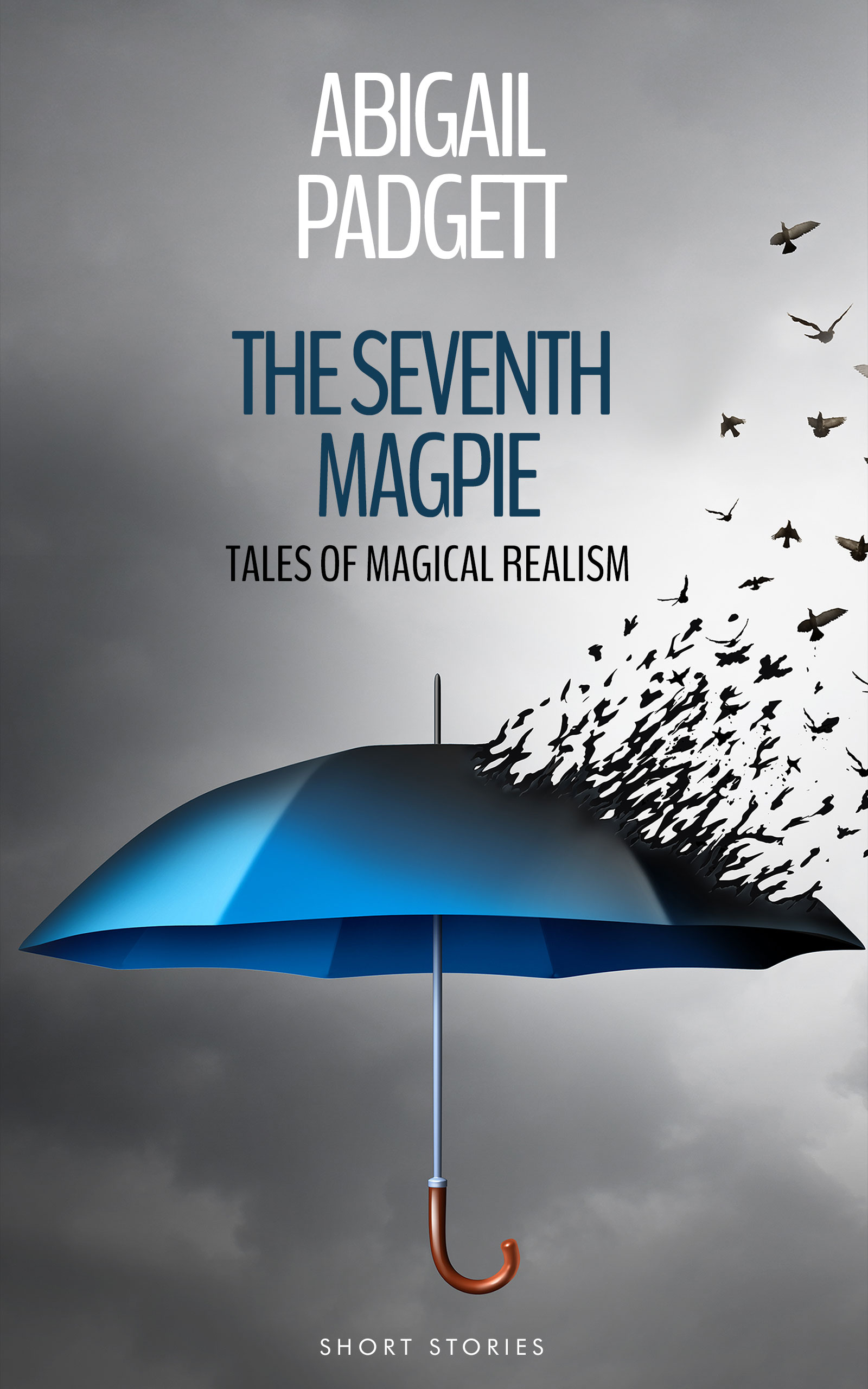
New little book, six magical realist short stories, arguably feminist magical realism. There is such a thing. I didn’t make it up, although I would have.
These stories have been sitting around in a computer file for ages. I didn’t know what to do with them. Magical realism, in which strange things happen unaccountably within perfectly normal circumstances, is not widely understood or popular in the U.S. It is generally associated with Spanish-speaking writers and more recently with oppressed minorities.
There were a number of online zines publishing MR, but all of them died at the same time. In 2017. That was when something very strange happened within what had been the perfectly normal circumstance of a presidential election. And the strangeness didn’t end. Suddenly we were actually living in a story that defied all rationality. A story of bad magic, all day every day. An impossible fiction was actually happening. It was real. From 2017 on, there was no longer any need for fictional magical realism.
That journey across a landscape of Things That Cannot Be may soon end. With a return to the reliably mundane world of normal circumstance, readers may safely again explore the curious realm of magical realism.
This brief anthology is meant to be a small flag on that landscape. Click on the cover to see it.
Posted in Uncategorized | Tagged ballet, Elliot Stabler, Guanajuato, haunted carousel, magaical realism, mummies, short stories | 4 Comments »
My furniture doesn’t think. Does yours?
Can furniture be racist? Apparently, along with anything else covert right-wing social media trolls gleefully use to PROMOTE racism, national division and the slaughter of U.S. democracy. If you live anywhere near the Mason-Dixon Line, you’d better hide great-grandma’s old rocker! Because if it was ever anywhere near a slave-run plantation (which it and everything else would have been in not only the South but also in New York, New Jersey, Delaware and Maryland), that rocker is troll-prey.
Anne Butler
My friend Anne Butler lives in the 210-yr-old main house of a Louisiana plantation in St. Francisville, Butler-Greenwood, belonging to her family since the 1700’s and on the National Register of Historic Places. Six cottages on the expansive grounds are B&Bs, and I was Anne’s guest there countless times while visiting my friend Doug in the nearby prison at Angola. This gorgeous, fascinating place is the setting for a serialized short story, The Hollering Tree, I wrote for the Lands’ End catalogue, and for An Unremembered Grave, a novel I loved writing because, well, it has a vampire. Butler-Greenwood is too much a part of my history to remain silent, but what has happened in regard to it extends far beyond a little village in Louisiana.

The Reconstructed and Now-Forbidden Parlor at NOMA
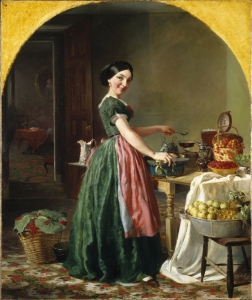
Until recently, Anne maintained areas of the main house as a museum, including the original Victorian formal parlor with its 12-piece set of (Connecticut-made) rosewood furniture in its original upholstery, floor-to-ceiling pier mirrors and Meeks étagère. That parlor, scrupulously recreated down to walls and windows, was transported in 2013 to the New Orleans Museum of Art. Except even if you’re really into Victoriana, you won’t be able to see it. Why? Because it’s boarded up now, forbidden, anathema to seeming “social justice” types who advocate burning history to the ground.
So who are these people who manage to hate pier mirrors and a marble-topped table for their proximity to a plantation? My guess is that they’re NOT righteously angry African Americans and white liberals, although they may account for a few. My guess is that these extremist social media attacks that are taking place all over the country are planned and carried out by highly-skilled professional trolls paid by right-wing organizations to amplify the social division that has torn this country apart.
Don’t fall for it!
Throwing statues in rivers, boarding up museum exhibits and annihilating intellectual platforms like the recent debacle laying waste to Poetry Magazine do absolutely nothing to change the lives of Black, Brown, Native and other disenfranchised Americans. What these tactics do is obscure what’s really going on – an out-of-control pandemic that’s killing Black, Brown and Native folks in brutal numbers, a desperate national financial crisis caused by federal incompetence, massive voter suppression, open corruption at the highest levels of both government and social organizations, all on a planet quickly dying under the corporate knife. And more subtly, these tactics make rational, thoughtful people recoil in discomfort because tactics like anthropomorphizing furniture are ridiculous. They drive a wedge between rational, thoughtful people and the very issues the trolls only pretend to advocate. The method is calculated and effective.
Just don’t fall for it. Call it out for what it is – politically-engineered melodrama designed to create an “Oh, for crying out loud, this has gone way too far!” attitude that can obscure real calls for social change. Instead, support an end to redlining, gerrymandering and voter suppression as you work for vastly expanded educational and health care resources for “underserved” Americans.
 And drop a courteous note to the New Orleans Museum of Art saying, “Please reopen The Greenwood Parlor exhibit, a treasure of Victoriana no item in which was in any way responsible for slavery because it’s just furniture!” Here’s the link – https://noma.org/
Posted in Uncategorized | Tagged Angola Prison, Anne Butler, Louisiana, NOMA, social media trolls, St. Francisville, Victoriana | 2 Comments »

The House NEVER Loses
The most fun about writing a novel isn’t writing it but researching it. Sadly, right now it’s not possible to just jump in a car and dash off to see, hear, touch, smell, and if it’s a restaurant, taste, a place you’re writing about. Everything’s closed. Unless you happen to be writing about a casino. On Native American land. Because a federally recognized tribe has the right to regulate activities on its land independently of state control. Bingo!
And since the tribes don’t have to pander to Republican politics, they’re free to follow scientific guidelines for Covid. Temperature checks at the door, enforced social distancing everywhere and any self-obsessed cretin who refuses to wear a mask will find himself escorted off the reservation by large, intimidating Native security guards. Wearing masks. Nirvana.
Luckily, my book-in-progress (a third Blue McCarron mystery) has a scene in a casino owned by the Viejas Band of Kumeyaay Indians, so yesterday we drove up there so I could get the details right. It’s just one scene, a flashy pop concert, but I’ve never been to a concert or anything else at a casino and wanted to get the descriptive fine points. You know, like the walls, the lighting, the carpet? And I could not make this carpet up!
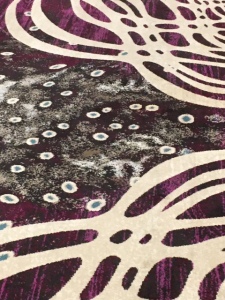
The Carpet
Walking on it, Blue will be forced to think of neural pathways invaded by a dark cloud of tiny flying saucers or fried eggs with blue yolks, a thought with no connection whatever to the story but that carpet is too interesting to leave out.
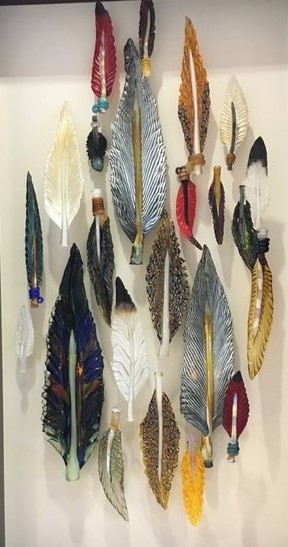
Glass Feathers
As are the glass feathers framed in the lobby. More pointless interior monologue about fragile, shattered feathers as a metaphor for something? Sure. But the most interesting aspect of this foray happened in a conversation with a drop-dead gorgeous descendant of the indigenous Puerto Rican Taino that provided enough information for 2 or 3 other novels. This is a problem with research. I got the carpet and feathers but also a wealth of information I wasn’t looking for!
At first Jasmene and I discussed her adult daughter’s seeming addiction to Q-Anon. The daughter has a master’s degree, shattering my assumption that educated folk automatically dismiss reports of satanic democrats kidnapping, raping and dismembering children as the production of some sick creep who’s paid handsomely to poison the minds of the not-too-bright. But this daughter is a smart, educated woman with a smart, educated mother, and she’s still terrified to take her small children out in public alone. She’s convinced that Satanist democrats will steal, defile and then slaughter them for salable organs. Jasmene’s rational arguments have no effect on her daughter, and I kept thinking this would make an interesting novel.
But then she told me about a Native activist group, No More Stolen Sisters, with which she’s involved. In Canada the sexual abuse and slaughter of First Nations women is recognized as an epidemic. In the U.S. the same epidemic quietly kills Native women and children who live anywhere near oil industry “man camps,” large tracts of rural temporary or permanent modular structures built to house the thousands of men who construct and maintain more than 190,000 miles of oil pipelines crossing the country. The carnage is particularly ghastly in remote areas of Montana and North and South Dakota where oil money rules, law enforcement jurisdictions are vague and investigations take so long that bodies decompose and vanish long before they can be found. It’s Ciudad Juárez all over again.

Activist Native women fighting to end this slaughter wear a red, painted hand over their mouths, symbol of both the official silence surrounding their missing numbers and their refusal to remain silent.
So a lighthearted trip to photograph a carpet, just something interesting to do during a pandemic characterized of necessity by boredom, changed the story I thought I was writing in a matter of minutes. Satanist democrats aren’t raping and killing children; that’s just sick QAnon propaganda. But Native women and children are being raped and killed. San Diego isn’t in North Dakota and the local Kumeyaay are running luxury casinos, not barely surviving in pitiless wastelands and subject to vicious exploitation by oil workers. But not all of them.
Across an artificial “Mexican” border thrown down by various warring European invaders, descendants of the same Kumeyaay ancestors struggle to survive in nearly inaccessible communities surrounding Tijuana and Tecate. With little water and acorns as a principal resource, most migrate to the nearby cities where they can find sporadic manual labor jobs. Illiterate and ill-equipped for success in a hi-tech 21st century, Kumeyaay women and girls in Mexico are easy prey for human traffickers engaged in the thriving border flesh industry.
That border is only 30 miles from my front door. Now all I need is a title for the book. It has to include the word, “Blue” and suggest some connection to Mexico or Native Americans or deserts. Suggestions welcome!
Posted in writing | Tagged book titles, casinos, Kumeyaay, No More Stolen Sisters, QAnon, researching a novel | 7 Comments »
 Comfortable with long stretches in the exclusive company of a computer, I figured a few months of quarantine from a deadly dryer-ball virus would be no big deal. When articles about various quarantine-induced psychological problems appeared in the four different newspapers I read every day, they weren’t about me. Not right away, anyway.
But then the flashbacks started. Maybe one every four or five days, lasting only a split-second but, well, odd. Not frightening or disorienting, but curiously intense. Plato or Aristotle famously said something like, “The one thing even the gods cannot do is go back in time.” An obvious truism, except I seemed to be doing just that. Going back in time.
These are not dreams or memories or any sort of “thought.” Neither do they feel like the giddy pot-or- Seagram’s-induced insights of much younger days. What they feel is absolutely real.
Example: It’s probably about 1950 and I’m sitting on the Main Street porch of my friend Sue, waiting to watch the 4th of July parade. Nothing’s happening yet; I’m just there. I’m aware of my skinny, breastless child’s body, my feet happily swinging below the porch 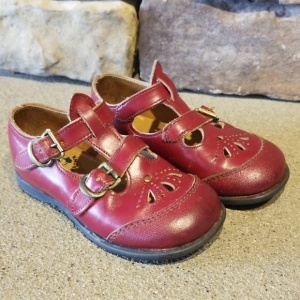 railing in Buster Brown shoes and thin, striped socks. And then it’s over and I’m incredulous and strangely pleased.
Or it’s even earlier, maybe 1948, and I’m coloring at a little table in my room. It’s a “school” coloring book with straight lines running to words at the edges of the page, “red, blue, yellow, brown,” telling what color to make the spoon, the dog, the tractor. Since it’s my own coloring book and not one from kindergarten, I can ignore the directions and color any way I want to! The window is open and a nice breeze ruffles my hair as my parents talk in another room. I know I am safe. Then it ends and I am grown up and not safe.
These are not traumatic, major or even significant childhood moments. They’re so ordinary, so mundane that prior to being them I couldn’t possibly remember them. They’re just momentary flashes from a childhood lost in time, dredged from meaningless history and actually lived again, if only for less than a second. But why?
My first thought was that I must be having TIAs, transient ischemic attacks, little strokes. But none of the symptoms were there – sudden weakness or paralysis on one side of my body, slurred speech, etc. “Becoming yourself as a child” is not listed anywhere in the stroke literature.
Okay then, I figured the source of these experiences must lie in the field of psychiatry. No problem. Having spent 30 years reading everything I could find about psychiatric syndromes and writing novels in which they figure significantly, all to understand the experience of a mentally ill family member, this stuff does not scare me. Instead, I find it fascinating. And indeed, 30-60 percent of people who are grieving the death of a loved one report “hallucinations” involving the deceased. I’ve had such experiences and wouldn’t use the psychiatric term to describe them, but there it is. So I must be grieving, right?
Not in the usual sense; nobody close to me, including a dog, has died for years. But something larger and more amorphous is literally and irretrievably putrifying in front of me – the idea that was my country. That American kid on a Main Street front porch was waiting for a parade that will never come again. Sniff.
The grieving theory has a poetic charm and works, but doesn’t feel right. I’m okay with the passage of time and don’t have any hallucination-producing unconscious obsession with the past. I cringe in shame at the pitiful, embarrassing joke my country has become, but that shame doesn’t manifest as grief. It manifests as very open loathing for an inept sociopath slathering on his orange makeup in the White House, for every cowardly, self-serving Republican officeholder and for their pathetically stupid supporters. They are destroying not only my country but the planet, and the damage cannot be undone. My reaction to them is far from unconscious, however. It’s not the genesis of my flashbacks. 
Then I read headlines saying that the Pentagon has declassified Navy pilot videos from 2004 and 2015 purporting to show UFOs. These videos have been circulating for years and the Pentagon declassified them to demonstrate their authenticity. They’re real and inexplicable, but that doesn’t mean their origins are anything but earthly, and I’ve never paid any attention to UFO theories anyway.
Except when I was a very little girl.
Back then I expected explanations, for everything, that were not available in religion or in anything available at my reading level. So I stood in my bed at night, watching through the window for extraterrestrials who would land their space ship in the back yard by my swing set and explain it all to me. They never came.
 A lifetime later I see, but don’t really read, something suggesting UFOs are really out there and not readily explainable. Bingo! Mindless fools continue to kill the only planet on which the human species can survive, an intolerable fact that makes no sense. But maybe, and only in the curious, trusting mind of a child, sense can be made, the intolerable stupidity can be crushed. Maybe in one of those split-seconds of lost childhood the extraterrestrials will show up at last and explain what happened here.
Do I think some metallic, cone-headed creature is going to appear in one of these fugue-states and tell me how to obliterate human greed and willful ignorance? No. But at least I get to choose the color of my tractor and swing my skinny little legs on a long-vanished porch again, and that will have to do for a while.
Posted in Uncategorized | 6 Comments »
 Goodreads lists 250 novels set in Louisiana and the list is not complete. Tennessee Williams, Kate Chopin and Anne Rice come immediately to mind and set certain categorical standards, but in their wake are legions, including me. I wrote An Unremembered Grave after spending twenty years visiting my pal Doug in Angola, frequently as the guest of Ann Butler at her plantation B&B in St. Francisville, Butler Greenwood. I was and remain captivated by the complexity of Louisiana, its spirit and eerie allure. But for the macho and more grossly accurate version of that writerly experience, nobody can hold a candle to James Lee Burke.
He gets it, gets its saint-and-sinner smile, its barely-dead ghosts and most of all, its demise beneath the wheels of change. He gets that its messy, beautiful soul in all its outrageous excesses is the unvarnished soul of a country.
Now he’s written another novel. Here’s my review of it.
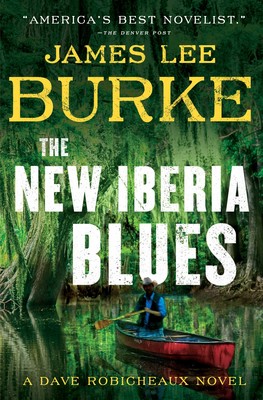
Travel once again into a mythical and creepy-dangerous corner of Louisiana that exists only in the mind of Detective Dave Robicheaux, stand-up guy. Robicheaux and his equally stand-up-even-when-drunk best bro Clete Purcell are in their eighth decade and Dave’s damsel-in-distress daughter Alafair has to be pushing fifty by now, but hey, archetypes cannot age. They exist in a Jungian collective unconscious that author James Lee Burke navigates like William Blake on a Bird scooter in rush-hour traffic. Hang on for the ride!
Clete sees a man in jailhouse garb jump from a train into a river and beats himself up for 447 pages in hardback for not reporting the event. Ten days later, Dave, visiting a local-boy-now-Hollywood-maven in town to film parts of an astronomically expensive and symbolically significant movie, sees the corpse of a woman nailed to a cross floating in on the bay. By page 17 the jumper turns out to be Hugo Tillinger, an escaped convict accused of burning his house to the ground with his wife and ten-year-old daughter inside. One page later we learn that the crucified woman is 26-year-old Lucinda Arcenaux, who’s been working for the Innocence Project trying to help wrongfully convicted prisoners. Including Hugo Tillinger.
It’s a nice set-up, but don’t even THINK you’ve been handed the backbone of a story. More like the bones of a thumb and a kneecap from a different skeleton. There are quickly more (many more) murders, each bizarre, brutal and exquisitely described. The Crusader’s Maltese cross turns up in a baby’s amulet and elsewhere, as do some of the major arcana of the Tarot deck. There are so many plot threads and delectably-described characters (including Chester Wimple, a small, disturbingly childlike hit man who trusts no one but Wonder Woman), whole arsenals of lovingly identified weapons and ammo, ghosts, hallucinations, hookers, blues singers and references to AA, old movies and organized crime that a truly dedicated reader will record names and details on recipe cards, tack them to a wall and then spend weeks with colored string trying to track the connections.
The result will be an impenetrable mess, but as NYT reviewer Marilyn Stasio said of this book, “But does anyone really read Burke expecting a coherent narrative?”
No. We read Burke because his poetic flair touches an American cultural base of longing for an imagined past in which there actually were good guys who respected women, loved animals and children, and never hesitated to track down and kill bad guys. Also because of that brain-worm he describes in each of us, the one that secretly relishes at least the idea of sickeningly violent retribution.
Burke in the Robicheaux tales is sort of the American Janus – two sides of the cultural coin, beauty and beast, saint and sociopath. Required reading in a time governed by the worm.
Posted in Book Review | Tagged James Lee Burke, Louisiana | Leave a Comment »
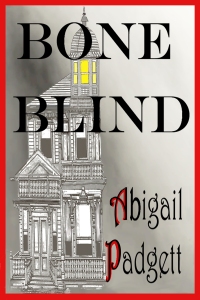
Of course there was a dead body in Boston, a man savagely murdered in an old Victorian house with an extremely unlikely weapon. But that’s only the beginning.
Enter two writers of horror novels, Finn Ryan and Tally Serzak, each burdened with secrets that make them a little odd, especially Tally, whom readers love to hate. (She really is a nightmare, but, you know – there’s a reason.) Let’s just say their love affair probably sets the standard in American fiction for romantic dysfunction. And still they can’t stay away from each other. A mad passion poisoned by a secret that can wreck both their lives.
Circling them and the murdered man in an ever-tightening gyre as Finn writes a Victorian horror novel in Boston and Tally lives in one on Cape Cod, is about-to-retire detective Warren Yost. He’s determined to solve the cold-case murder before he hangs up his service revolver and goes into business restoring – yes, old Victorian houses. (There’s a wealth of Victoriana in this tale!)
Bone Blind will be only 99 cents in the Amazon Kindle store today and tomorrow, Friday August 9 and Saturday August 10, 2019. Click on the cover pic, grab one and settle in for lots of murder, passion, betrayal, revenge and mysterious Victorian bric-a-brac!
Posted in mystery, writing | Tagged Boston, Cape Cod, horror novels. police procedurals, Victoriana, writers | Leave a Comment »
The perfect summer beach read! Well, depending on your beach. Try to find one where something strange was buried 150 years ago. Look for a mossy, isolated prison looming nearby, and invite a young historian who isn’t what she seems to share your s’mores. The sun will be a problem for one of the characters, so maybe bring a big beach umbrella. A black one. He’ll appreciate the gesture.
An Unremembered Grave will be free for Kindle starting today, Friday, May 24, through Tuesday, May 28.
And when you back out of the parking lot at the beach, don’t just depend on your mirror. Look over your shoulder. Because, you know, not everybody has a reflection.
Posted in mystery, vampire, prison, Louisiana, history professor, quilts, slavery, Civil War | 1 Comment »

It’s done. All the Bo Bradley mysteries, including the latest, have new, matching covers, with crows! Yes, crows.
I didn’t realize until writer-pal Mary Lou Locke pointed out to me that there are crows in pretty much all the Bo novels. (A stranger at a booksigning years ago also had to inform me that “Bo Bradley” sounds an awful lot like “Boo Radley,” the reclusive and undoubtedly mentally ill character who only comes out of hiding to save threatened children – the mysterious figure who gives Harper Lee’s To Kill a Mockingbird its title. Of course! Except I had no idea.) Unconscious influences are afoot the second anybody sits down to write a novel and Bo-as-Boo makes sense, but why crows?
They don’t play roles in any of the plots; they’re just there. Bo is aware of them, watches and describes them through six perilous adventures as they watch her, but they don’t do anything. Except, I guess, reprise their own ancient symbolism as, with ravens, magpies and all corvids, the universal totem animal of mystery, intelligence and transformation, including death. Bo is Irish, and in Celtic cultures crows were so highly regarded as oracles that under Druidic law killing one was a felony, so there’s that. But I rather imagine Bo herself, with her quirky, fractious, bipolar mind, reflects crowness entire. And now all her book covers, thanks to the patient skill of cover designer Cheri Lasota, are embellished with those black feathers. Be sure to let me know which one you like best!
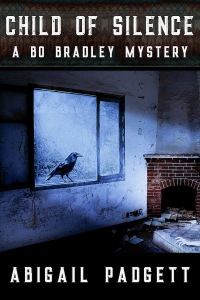
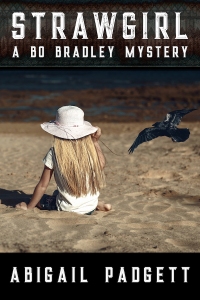
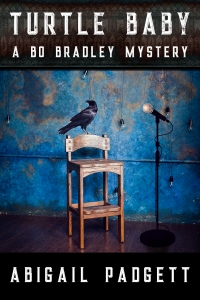
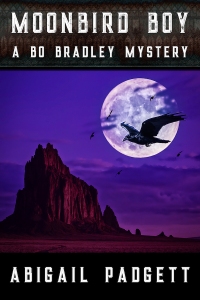
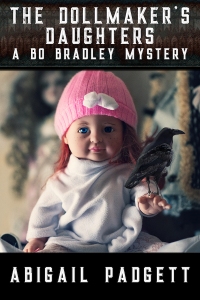
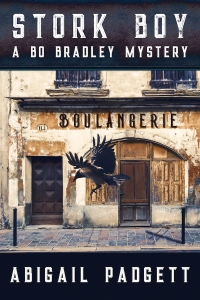
And also help me decide what to write next.
Seriously.
 I’ve been dying to write the sequel to An Unremembered Grave, taking Danni and the vampire Grimaud one step further toward her mysterious past and their dangerous connection, but it’s time for Bo and Andrew to head for Louisiana and a Cajun wedding – omg, their own! (You know Bo is going to balk every inch of the way, so there may not even be a wedding. We’ll see.)
So which setting? The little-known limestone caves beneath the streets of St. Louis for Danni, or Spanish moss and crawdad étouffée in Louisiana for Bo?
Posted in mystery, writing | Tagged book covers, crows | 10 Comments »
 abigail padgett